Your Image, Rebuilt on Tape
A photograph on your phone is very good at staying on your phone. It can remain there for years, between a picture of a receipt and seventeen attempts to persuade everyone in the family to look in the same direction.
Choosing one image for the wall is a different exercise. It asks which picture you want to encounter again, and what form will help you enjoy it.
At Mixtape Mosaic, you can upload your own image and turn it into an artwork built from real vintage cassette tapes. The photograph becomes a composition across shells, openings, and seams. It acquires a physical surface.
The personal meaning comes from your image. The material gives it another way to be seen.
Begin with the image that matters
You do not need the most formally impressive photograph you have ever taken. You need a picture whose subject you want to live with.
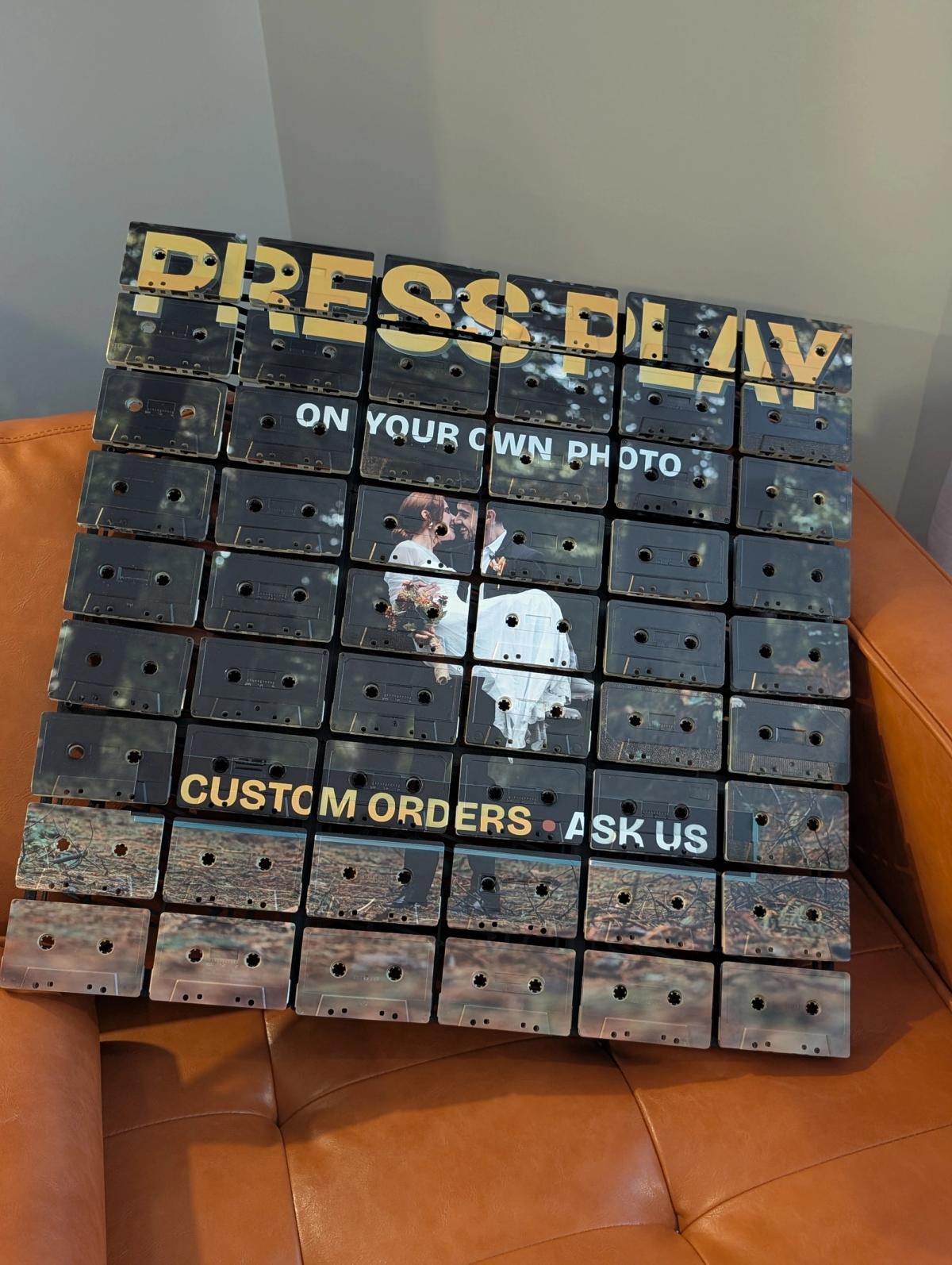
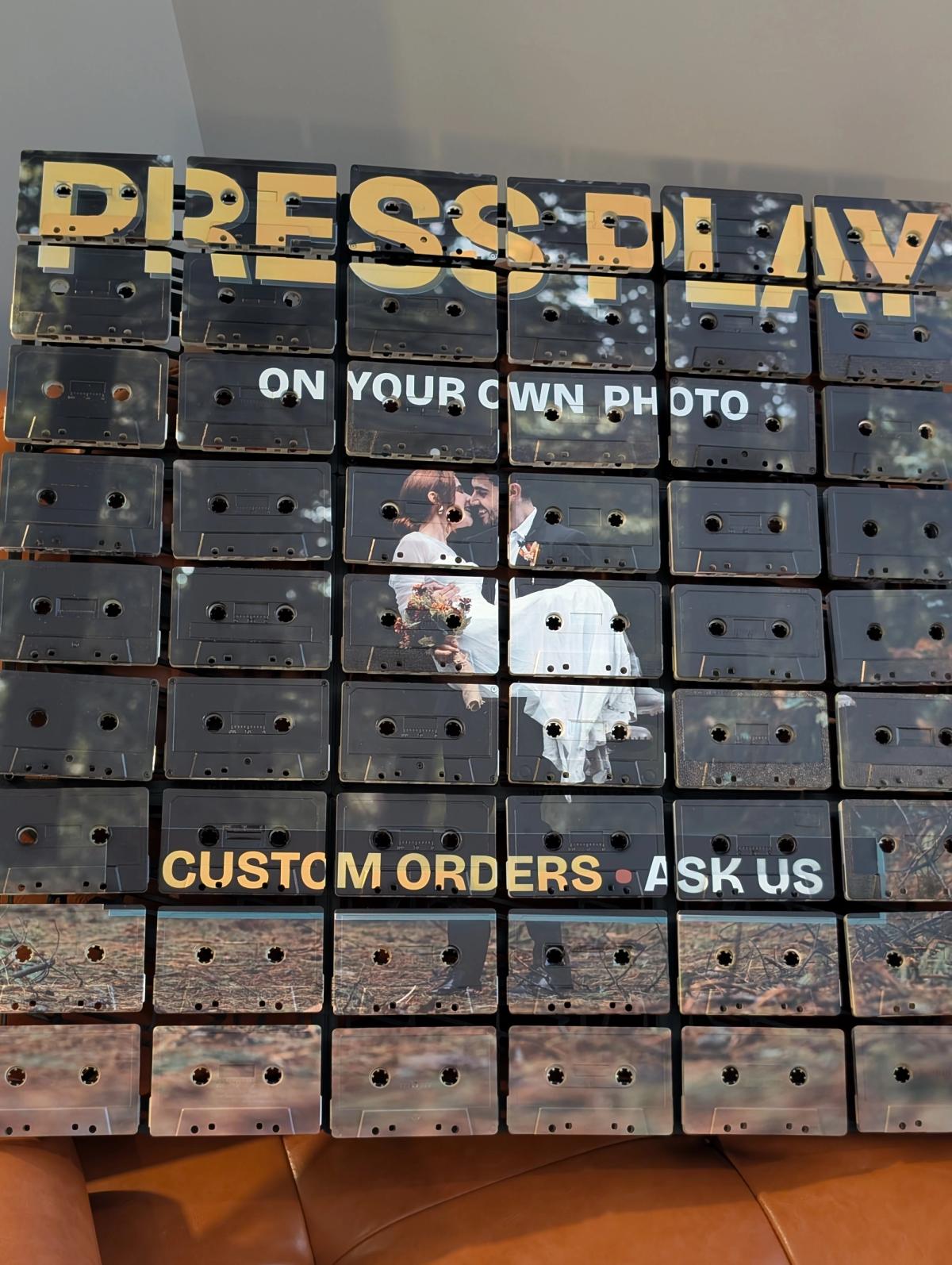
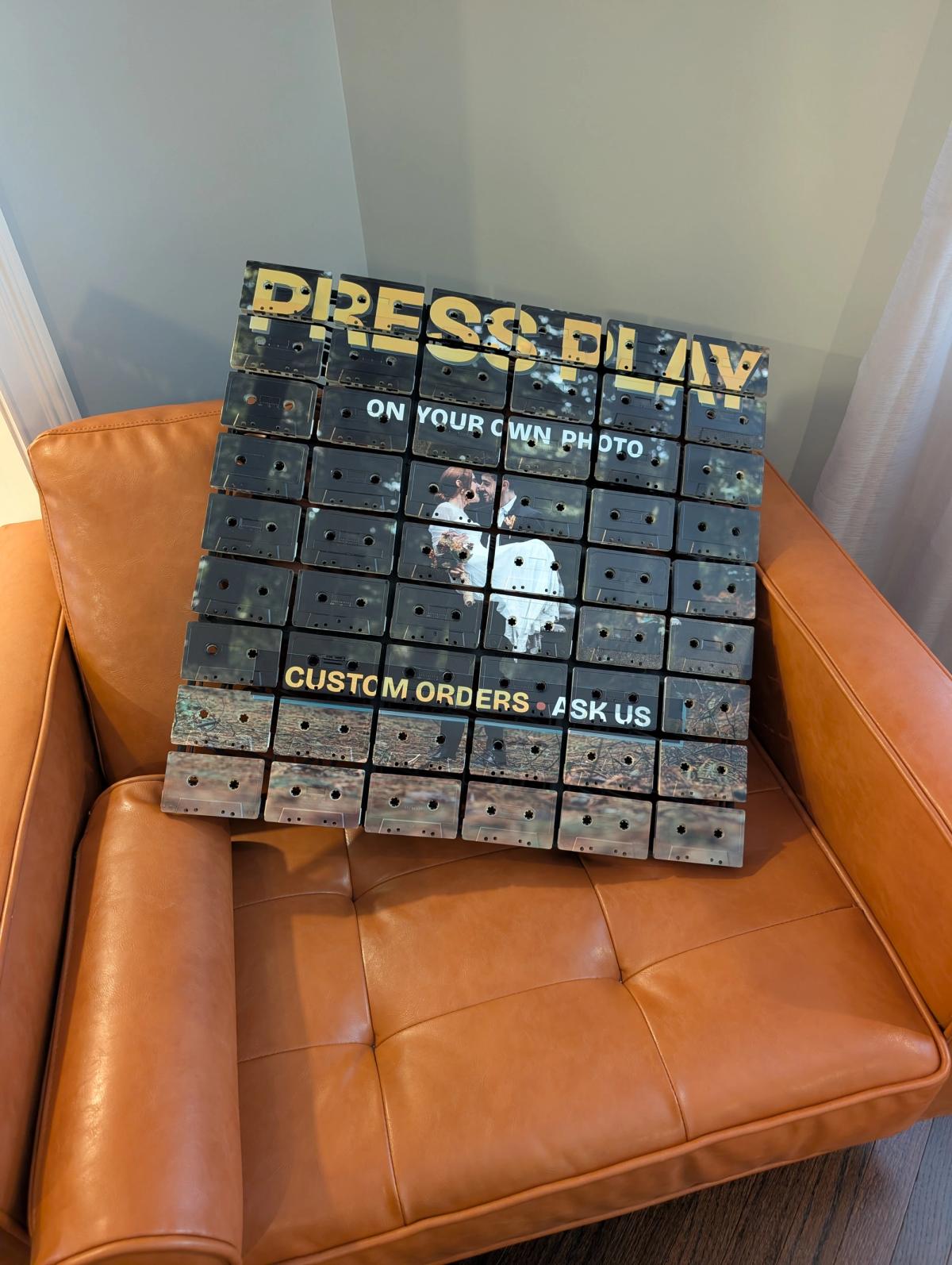
That could be a person, a pet, a place, a drawing, or an image you made yourself. The custom-photo demonstration in these photographs puts a personal subject at the centre of a cassette grid. Its “Press Play” lettering explains the example; your own image and preview determine your composition. It makes the idea immediately understandable: your own picture can become part of this material language.
Meaning and visual suitability are separate questions, and both deserve attention. A photograph can matter enormously and still need a different crop to work well on tape.
Choose a few candidates if you can. Look for a clear subject, enough contrast to distinguish it from the background, and a source file with sufficient detail. Then use the preview to decide which composition carries best.
Use the best file available
Start with the original, high-resolution image when possible. A downloaded social-media image, a screenshot, or a heavily compressed copy may have lost detail before you reach the customizer.
The useful question is how the file looks at the scale you intend to use. A photo that seems sharp as a small thumbnail may look soft when enlarged over a larger artwork.
Open the file and look closely at the important area: the eyes, a face, the outline of a pet, lettering, or whatever you most want the finished piece to preserve. If the source is already blurred there, a larger print will not recover it.
You can upload artwork as well as photographs. Use images you own or have permission to use. If you are uncertain about suitability, ask the studio before committing to the order.
The highest-quality file in the world is still allowed to contain an unhelpful background. Resolution and composition are different departments.
Treat the grid as part of the picture
The cassette openings and seams remain part of the finished object. Your image will cross them.
A large, clear subject generally gives you more room to work. A tiny face surrounded by a great deal of scenery may be harder to read. Fine text and small essential details deserve particular attention in the preview.
Look at where the important features land. Does a seam pass through the part of the face that carries the expression? Is a small detail being interrupted by a reel opening? Would changing the crop or scale give the subject a clearer position?
The aim is not to avoid every opening. That would be a demanding task on a surface built substantially around openings. The aim is to make the image work with them.
A strong outline can survive a break. A tiny feature sometimes cannot. The preview is where you decide which is which.
Crop for the artwork
The shape of your original photograph does not have to dictate the shape of the finished work. Consider the available configuration and compose the image within it.
A closer crop can give a person or pet more presence. A wider crop can retain the setting that makes the image meaningful. A square can concentrate attention differently from a broad landscape.
Try those possibilities deliberately. Do not assume the first crop is correct merely because the software has presented it with confidence.
For a family image, consider whether everyone remains readable at your chosen size. For a landscape, identify the main visual anchor. For graphic artwork, check whether the strongest shapes still hold together across the cassette divisions.
The room guide can help you connect those decisions to the wall where the piece will live.
Image and material are both present
Artwork is UV printed onto the cassette faces, and the tapes are assembled in our panel system to create a dimensional piece. The image is carried by real vintage shells.
That gives a custom photograph a particular character. It reads as your picture, but it also reads as a constructed object. From farther away, the overall subject leads. Up close, you see the image meeting the physical tape details.
Those details vary. The preview establishes the intended composition; it cannot promise identical shell colours, labels, surface marks, or every tiny alignment in the finished build.
It is useful to know that before ordering. You are choosing a personal image in a medium that has its own physical character. The appeal lies in how those two things work together.
Personal does not have to mean elaborate
A custom piece does not require a speech explaining why the image was chosen. Sometimes it is simply a photograph that makes you happy.
There is also no requirement to make the picture music-themed. The cassette material supplies that connection. Your image supplies the subject.
That freedom matters to Mixtape Mosaic. We want a recognisable material identity with room for very different tastes. The artwork should feel like yours because you chose what matters, not because you adopted a complete set of studio preferences.
A photograph can hold a person, a place, or a moment you would like to keep close. Bringing it into a room gives it a place in your ordinary day. That is a good reason to make something physical.
Start with your best available file. Give the composition a careful look. Then let the familiar little cassette carry something new.
Upload your image