Repetition, With Exceptions
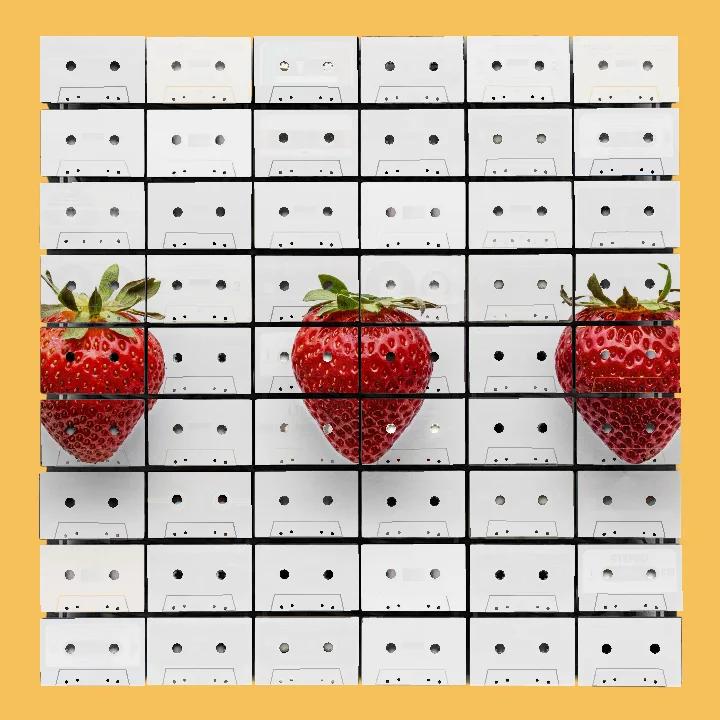
The third strawberry is where repetition stops being an accident.
One strawberry can be a subject. Two might be company, or a mild administrative error. Three, placed across a field of cassette faces, establish a pace. Your eye finds the first, anticipates the next, and then checks whether the third will obey. It does, though not with the dead obedience of wallpaper. The image has to cross windows, screws, label areas and the narrow gaps between real vintage cassettes. The beat continues. The surface keeps interrupting it.
That small contest is one of the useful things about repetition in Mixtape Mosaic art. A repeated shape can make an artwork immediately legible from across a room, while the cassette faces reward the slower, nosier inspection that follows. The artwork says strawberry. The objects underneath quietly say: have another look.
Repetition sets the pace
Every Mixtape Mosaic begins with a grid, so the composition is counting before an image arrives. Rows and columns establish intervals. Cassette windows and openings add smaller marks within those intervals. Edges divide the image into units. Even the shadows, which change as light moves across the dimensional panel, repeat down the rows with slightly different emphasis.
This means a repeated motif does not enter an empty field. It meets a structure already in progress, rather like arriving at a meeting where everyone has chosen a chair and the biscuits have been allocated according to a system nobody will explain.
The interesting question is not whether the pattern is perfect. It is what happens when the pattern and the cassettes disagree by a few millimetres.
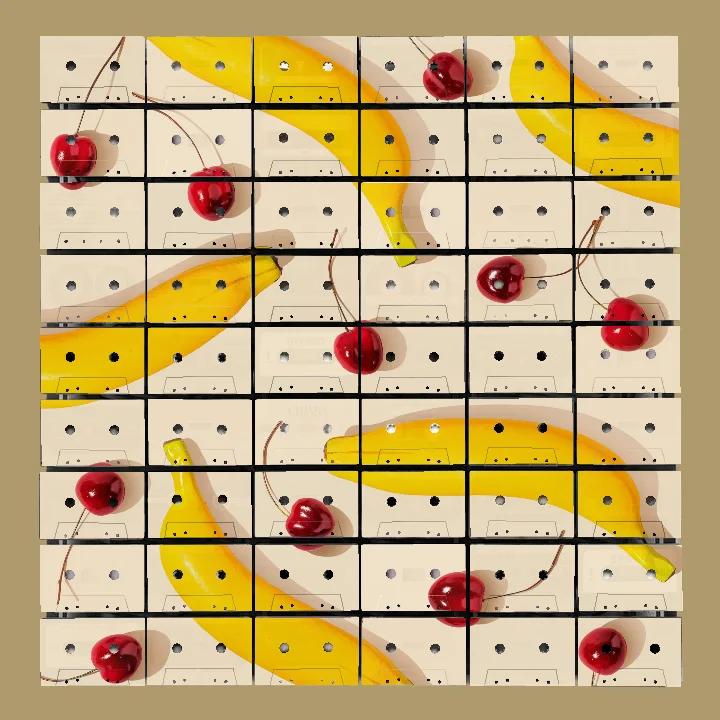
Three ways to repeat a shape
The strawberry study is the clearest count. Three large red forms sit against white, each given enough room to remain distinct. The eye reads the gaps almost as strongly as the fruit. That makes the work calm, but not static. The repeated form carries you from left to right, then the cassette grid pulls you up and down. My own eyes attempt both routes at once and achieve roughly what you would expect from a man trying to leave a roundabout while reading a map.
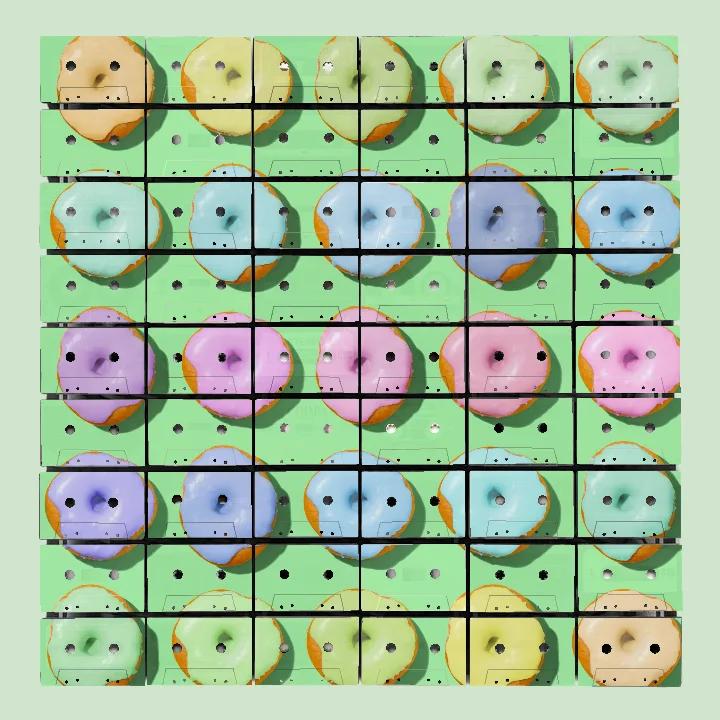
The pastel doughnut study behaves differently. Here the motif becomes an all-over field. Rings repeat across the panel in changing colours, and the regular cassette grid acts as a stricter counter-rhythm underneath. A doughnut may spread across several faces; a cassette window may land inside the printed ring; a shell edge may divide one colour from the next. The pattern is plentiful, but the material stops it becoming frictionless.
Bananas and cherries offer the loosest arrangement. The yellow curves occupy more space, while the smaller red cherries punctuate the gaps. The spacing varies. Your eye cannot settle into a single count, so it hops between shapes and colours instead. This is still repetition, just repetition with a slightly untidy desk and no intention of apologising for it.
The grid is not neutral
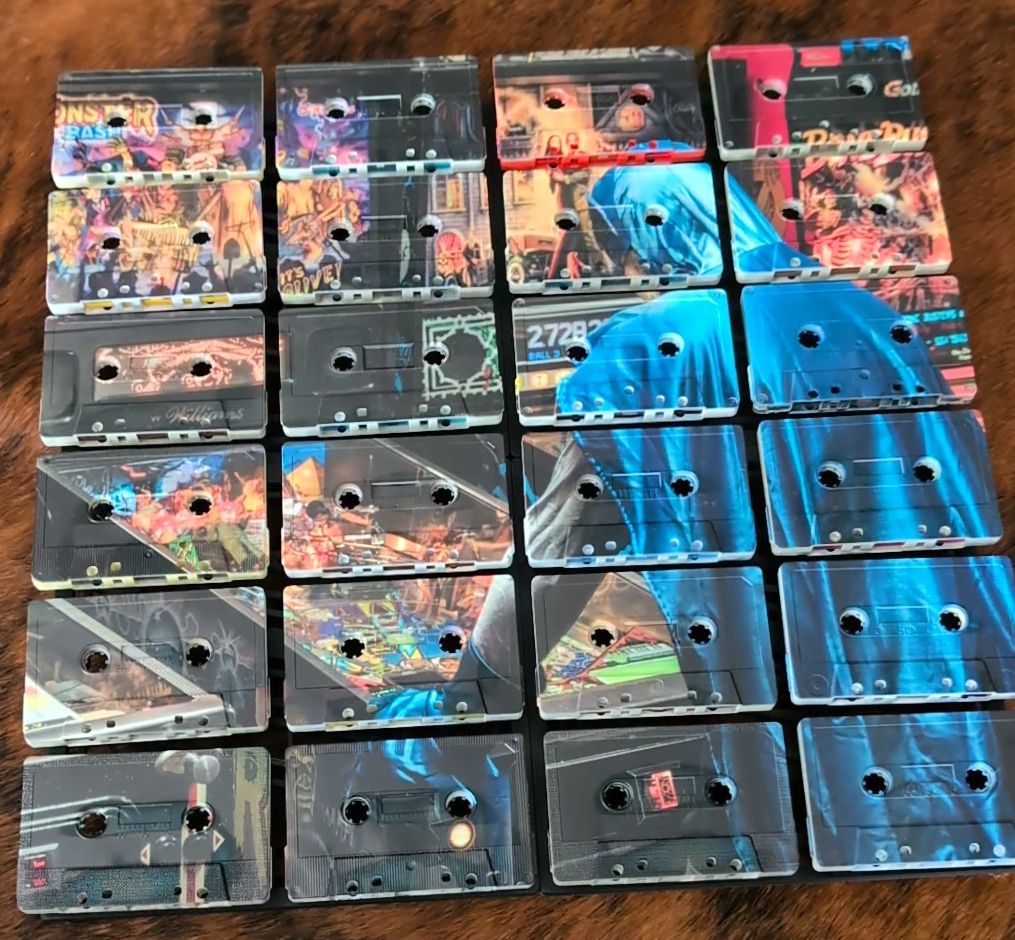
It is tempting to describe the cassettes as a canvas. They are not. Canvas generally has the manners to stay quiet. A cassette face arrives with geometry of its own: two spool openings, a central window or label zone, screws, ridges, bevelled edges, and the accumulated differences between one shell and the next.
UV printing carries the contemporary image across that varied surface, but it does not pretend the surface has disappeared. Lighter colours can leave more of the original cassette visible. Darker or more saturated areas can read as bolder blocks. At a join, a curve becomes two curves separated by a slim shadow. On a light area, an old label detail may remain perceptible beneath or beside the new image, a modest bit of evidence that the object had a life before it joined the composition.
That evidence matters particularly in repeated work. A perfectly smooth repeat can become background very quickly. Here, each recurrence meets a different cassette face. The motif is the same; the event is not.
Variation keeps it awake
Repetition gives the room an immediate read. Variation gives the artwork staying power. This is why the most useful comparison is not between order and disorder, as though one of them has left muddy shoes in the hall. It is between different kinds of attention.
Regular spacing, as in the strawberries, makes each deviation easy to notice. An all-over repeat, as in the doughnuts, makes the panel feel abundant before the eye begins sorting individual colours and tape faces. A scattered repeat, as in the bananas and cherries, keeps the route unpredictable. None is inherently louder or quieter. Scale, contrast, subject and surrounding wall all take part.
If you are choosing patterned art, try three questions:
- From across the room, do you notice the subject, the colour, or the repeat first?
- Up close, which cassette detail interrupts the image most pleasingly?
- If one motif vanished, would the composition lose its balance or merely become easier to count?
The third question is especially good because it makes one stare at an artwork for an unreasonable amount of time while appearing extremely purposeful.
What the repetition is for
There is an honest pleasure in recognising something more than once. The repeated form becomes familiar, then the physical differences ask us to look again. That balance feels true to Mixtape Mosaic: a contemporary image held by objects that refuse to become anonymous.
The cassettes do not serve as a novelty attached to the picture. They shape its tempo. They decide where a line breaks, where a colour catches, and where a shadow turns one repeated form into a slightly different version of itself. The grid gives order. The old objects keep that order human.
Explore the artworkThe Mixtape
J-card: “THE GRID IS ALREADY COUNTING”
Side A
- Steve Reich, “Music for 18 Musicians”: a pulse that proves repetition can keep changing without abandoning its structure.
- Philip Glass, “Opening”: recurring piano figures with enough movement inside them to make stillness impossible.
- Donna Summer, “I Feel Love”: the repeated electronic pattern is the floor; everything else learns how to move across it.
- Laurie Anderson, “O Superman”: one returning syllable turns into architecture.
- Stereolab, “Metronomic Underground”: repetition delivered with admirable faith in the listener's ability to remain alert.
Side B- The Field, “Over the Ice”: tiny repeated pieces gather into something far larger than their ingredients suggest.
- Caribou, “Sun”: a single word returns until it behaves less like language and more like colour.
- ESG, “Moody”: spare, exact and unwilling to add anything merely because there is space.
- Todd Terje, “Inspector Norse”: a repeating figure that keeps acquiring brighter furniture.
- NEU!, “Hallogallo”: forward motion with the unnecessary parts calmly removed.