A Good Fragment
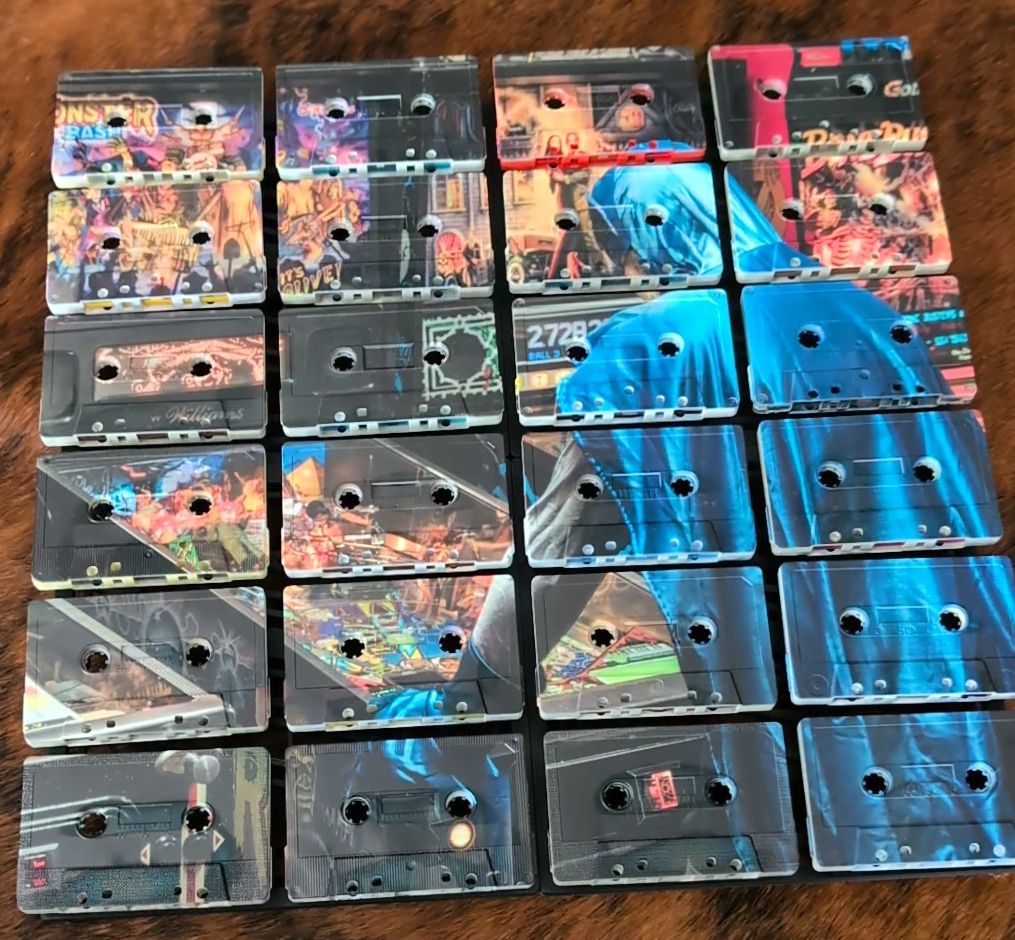
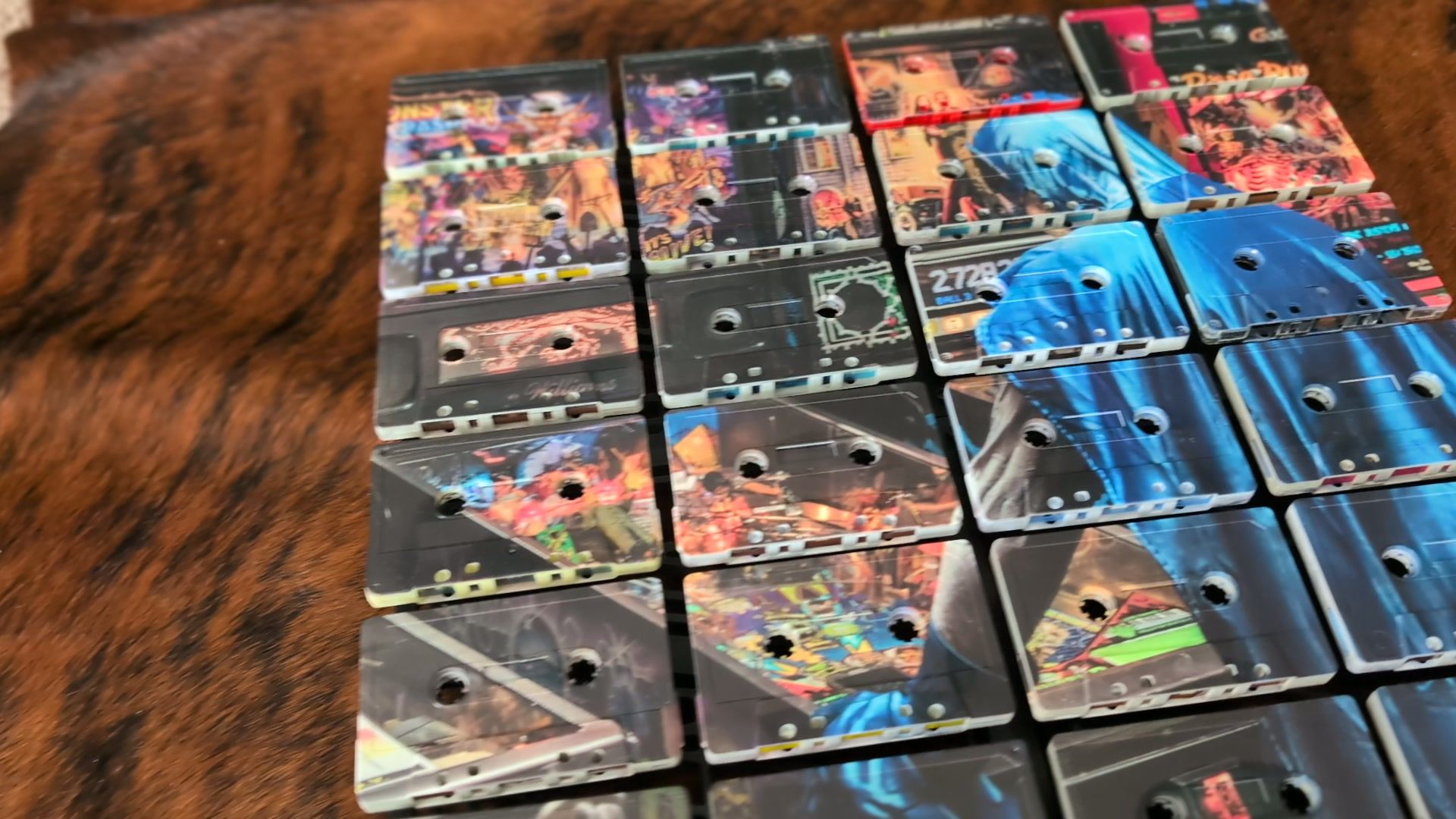
Take the cassette at the far right of the fourth row in the photograph below. Count from the top. It carries blue, darker blue, and a few narrow highlights, which is not much of a plot if you are expecting every cassette to explain itself independently. I am inclined to expect this. Give me twenty-four rectangles and, apparently, I want twenty-four small exhibitions, each with an adequate introduction.
The blue rectangle has other responsibilities.
Follow its folds into the cassettes above and below, and it becomes part of the clothing of the figure on the right. Nothing has been added to that particular tape. Its neighbours have simply supplied the information it cannot supply alone. This is one of the pleasures of a Mixtape Mosaic: an individual cassette can be visually incomplete and compositionally exactly right.
One picture, different jobs
This studio piece has four columns and six rows of real vintage cassettes. A contemporary image is UV printed across their faces. On the left, small bright details crowd together around pinball imagery; on the right, a larger blue form runs through several rows. The same rectangular unit carries very different amounts of visual activity.
Look at the second cassette from the left in the fourth row. There are warm colours, dark areas, and a pale diagonal crossing it. Its neighbour at the far right has those longer blue folds. One gives the eye several things to examine. The other helps establish a larger shape.
Neither needs to compete for the position of most interesting cassette. A composition in which every part insists on being the centre is rather like a meeting in which everyone has brought a presentation. Some restraint is welcome.
What the neighbours contribute
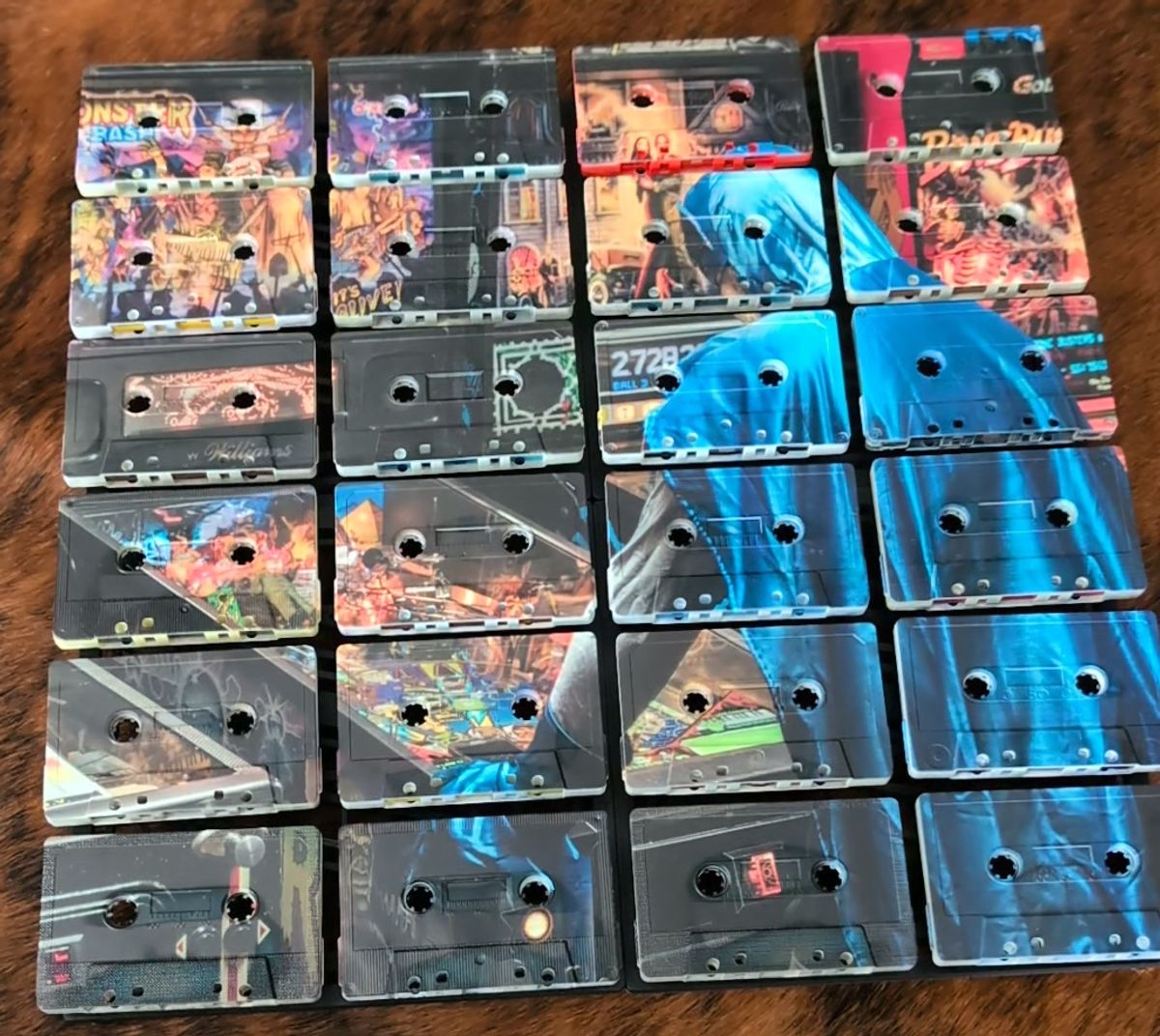
Isolate that blue cassette in your attention for a moment. The changes from light to dark suggest folds, but the rectangle alone gives you little evidence of the figure's scale or posture. Reintroduce the row above, and the blue belongs to a broader area. Include the upper part of the artwork, and you can follow it towards the hood.
That is a relationship, not a missing detail waiting to be repaired. The fragment contributes direction, colour and continuity. Its meaning depends partly on where it sits.
The pale diagonals in the lower-left portion offer another route through the picture. They cross cassette boundaries instead of politely stopping at each edge. You can follow a line out of one rectangle and find its continuation in another. The physical units remain separate; the image asks you to connect them.
This is more specific than saying that lots of tapes make a picture. Each tape occupies a particular position within that picture. A blue passage beside another blue passage can sustain a shape. Put it beside a cluster of warmer marks and the contrast becomes more pronounced. The neighbours change what you notice, even though the fragment itself has not changed.
A printed passage is not an empty one
The quieter blue area is still carrying the artwork. It is not the same thing as an intentionally unprinted area that lets more of an original shell or label show. Here, the printed colour itself is doing the work: holding a larger form together while other parts carry smaller, more numerous details.
That distinction matters when looking at the close view. There are reel openings, moulded outlines and lower edges within the blue passage. They are features of the real cassette beneath the image, not little pictorial details added to fill an otherwise insufficient rectangle.
Mixtape Mosaic brings those two kinds of information together. The printed fragment belongs to the composition. The cassette face remains a physical object with its own shapes. Neither has to account for everything you see.
A small looking exercise
You can try this with the photograph, without detaching anything from an artwork or conducting an experiment on the dining table.
- Choose one cassette and describe only what falls within its edges: a colour change, a diagonal, a patch of small detail. Leave the subject's name out for now.
- Follow one of those features into an adjoining cassette. Notice what the second fragment clarifies, extends or contrasts with.
- Return to the complete image. Ask what would be lost if that first area were as busy, or as quiet, as everything else.
There is no approved answer to the third question. It is a useful way to notice a supporting part without demanding that it become a focal point. I find the demand surprisingly difficult to abandon. Apparently even a rectangle of blue is expected to justify its time.
What deserves a second look
The parts that first attract us are not always the parts that keep an image together. A stretch of colour can give a complicated passage somewhere to settle; a continuing line can make separate objects feel related. Those contributions deserve attention too.
That is something we value in this art. It allows a cassette to be both a particular object and part of something larger, without requiring it to stop being either. You can choose a favourite fragment. It will still need its neighbours.
Look through the artworkJ-card: Parts in Company
A listening sequence for following one part, then letting the arrangement back in. These are selections for this article, not a claim about what was recorded on the pictured tapes. Pencil the title onto the J-card; leave room to change your mind.
Side A
- Booker T. & the M.G.'s, “Green Onions”: follow the organ phrase, then attend to what keeps it moving.
- Herbie Hancock, “Cantaloupe Island”: keep the repeating piano figure in your ear while the foreground changes.
- The Dave Brubeck Quartet, “Take Five”: listen beneath the saxophone melody for the accompaniment's persistent shape.
- Bob James, “Nautilus”: trace the bass movement through the keyboard textures.
- The Meters, “Cissy Strut”: notice the short spaces between the parts as much as the parts themselves.
Side B
- Khruangbin, “Maria También”: follow the guitar, then give the bass the same attention.
- Yussef Dayes featuring Venna & Charlie Stacey, “Black Classical Music”: let the drums lead your listening without losing the surrounding lines.
- Nils Frahm, “Says”: stay with the repeating figure as the sound around it expands.
- BADBADNOTGOOD, “Speaking Gently”: listen for how the chords support the more prominent phrases.
- Four Tet, “Two Thousand And Seventeen”: follow the bright recurring motif, then hear the quieter layers that give it somewhere to sit.