The Perfect Imperfection
I once spent nine minutes trying to straighten a cassette that was not crooked.
This conclusion arrived only after I had adjusted the tape twice, consulted a ruler, stepped back, frowned professionally, and discovered that the table itself was slightly uneven. The cassette had been innocent throughout. I apologized, although not in writing.
The incident confirmed a principle I have long suspected: perfection is frequently an administrative error.
A brief history of things refusing to match
Authentic vintage cassette tapes do not arrive as a coordinated set. Some shells are clear. Others are smoky, black, cream, or a color best described as "formerly white." Labels may be typed, handwritten, faded, torn, or attached with the unwavering confidence of an adhesive no longer approved for domestic use.
This variation is the point.
We source tapes from flea markets, estate sales, thrift stores, record shops, attics, old collections, and storage finds. They have been played, carried, labeled, misplaced, rediscovered, and occasionally stored beside objects that should not have been damp.
By the time they reach the studio, the tapes have already become specific.
A new replica can imitate the shape of a cassette. It cannot imitate the history of one without becoming unbearably theatrical about it.
The preview and the parliamentary limits of certainty
The preview in our customizer shows the composition, palette, crop, and overall direction of a finished piece. It is useful, realistic, and significantly better at predicting wall art than the Oracle of Delphi, whose customer support department closed around the fourth century.
It is not a guarantee that every shell, label, screw hole, rotation, or scuff will appear in precisely the same place.
No two builds match tape for tape because we use real vintage media. We keep the artwork consistent while allowing the materials to remain honest. A darker shell may deepen one portion of the image. A pale label may interrupt a saturated field. A handwritten title may appear where no digital designer would have placed it, which is often exactly why it works.
This position was ratified by the International Council on Minor Irregularities after its contentious 1988 conference in a hotel ballroom near Milwaukee.(1) The vote was unanimous except for one delegate who had become trapped behind the refreshment table.
Cleaning without performing an exorcism
Every cassette is cleaned and inspected by hand. We preserve original labels and markings whenever possible. Other tapes are carefully prepared to carry more of the transferred artwork.
The intention is not to erase the tape's former life. It is to make room for the new image while retaining the evidence that the object existed before we found it.
This requires judgment. Clean too little and the surface may not be ready. Clean too aggressively and the tape loses the very character that made it worth rescuing. The correct approach falls somewhere between conservation and asking a stubborn jar lid to reconsider its position.
There is no machine setting called "remove dust, retain emotional residue." We checked.
Why irregularity creates depth
A conventional print generally asks its surface to disappear. Paper supports the image and then has the decency not to interrupt.
Cassette shells are less deferential.
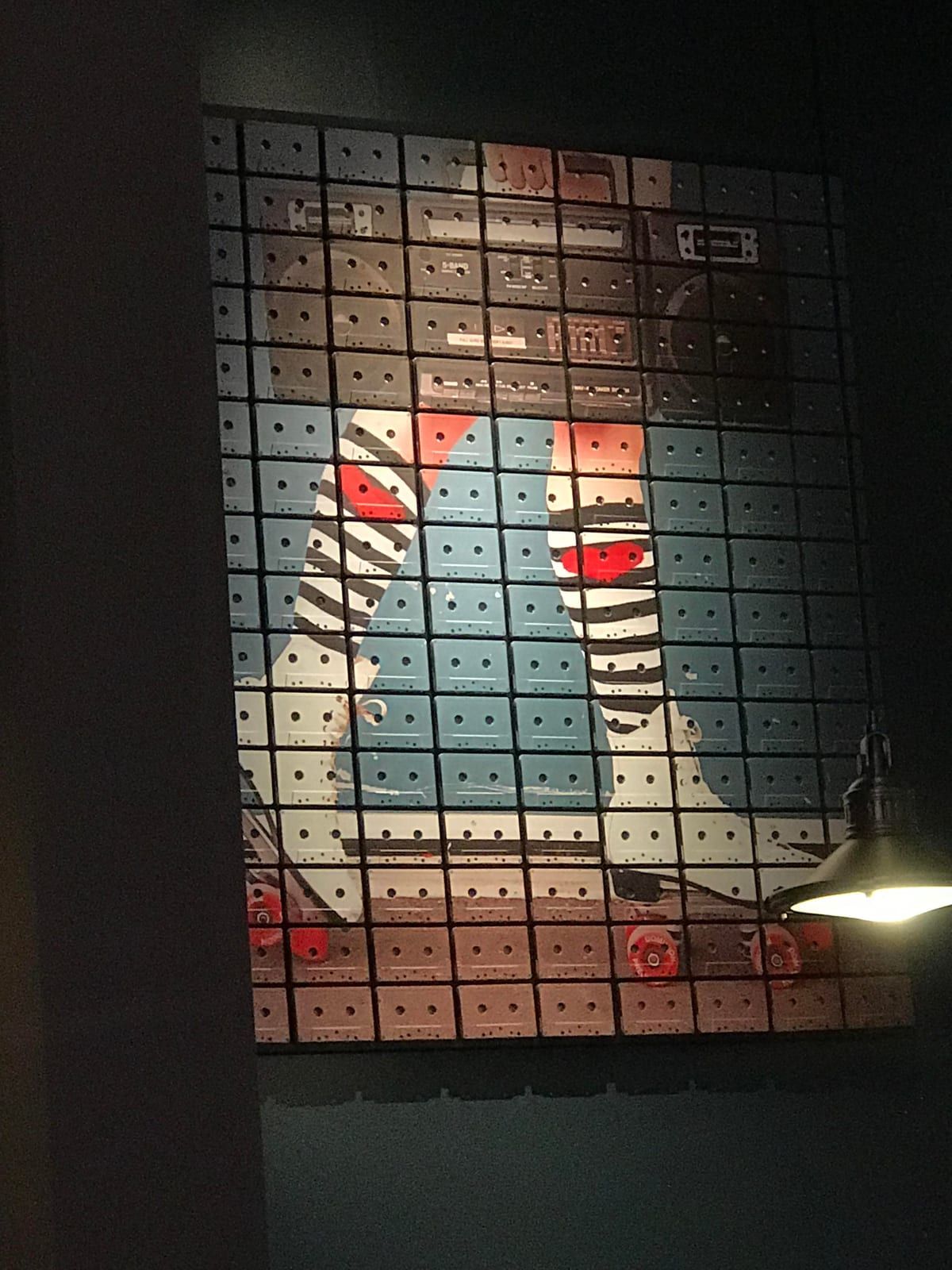
They have thickness. Windows sit at different levels. Hubs, ridges, labels, screws, and molded details catch light. The narrow spaces between tapes remain visible. As you move through the room, shadows shift across the grid and the artwork changes slightly with your angle.
From a distance, you see the complete composition. Up close, the picture gives way to dozens of objects. The surface refuses to become neutral, which is why the work has such physical presence.
It is part image, part archive, and part assembly of small plastic witnesses.
Handmade means someone stared at it from the doorway
Each piece involves sourcing, cleaning, sorting, artwork preparation, testing, assembly, and repeated inspection from several distances.
The doorway test is particularly important. One must stand at the threshold, narrow the eyes, and behave as if evaluating a minor but consequential clause in a maritime treaty. If the image holds together, progress has been made. If not, someone returns to the grid.
This is not the fastest method of making wall art. Speed was never the central ambition.
The ambition is to create something that could not exist without the objects used to build it. Two mosaics may share the same composition, but the tapes underneath will differ. Each will have its own labels, marks, surface changes, and peculiar little negotiations between color and history.
The innocent cassette
Eventually I moved my ruler to another table. The supposedly crooked tape remained exactly where it was and immediately looked correct.
There is a lesson here, although I distrust lessons that arrive before coffee.
Perhaps perfection is not the absence of irregularity. Perhaps it is the moment when all the irregularities stop asking permission and begin working together.
Or perhaps the floor is uneven.
In either case, the cassette was right.
Notes of dubious authority
- Proceedings of the International Council on Minor Irregularities, "Uniformity and Other Preventable Conditions," Milwaukee Adjacent Session, 1988.
- The doorway test is recognized by seven out of nine studio cartographers, a profession that may have been invented for this sentence.